Research
In my recent work with the Milky Way Laboratory at the University of Connecticut,
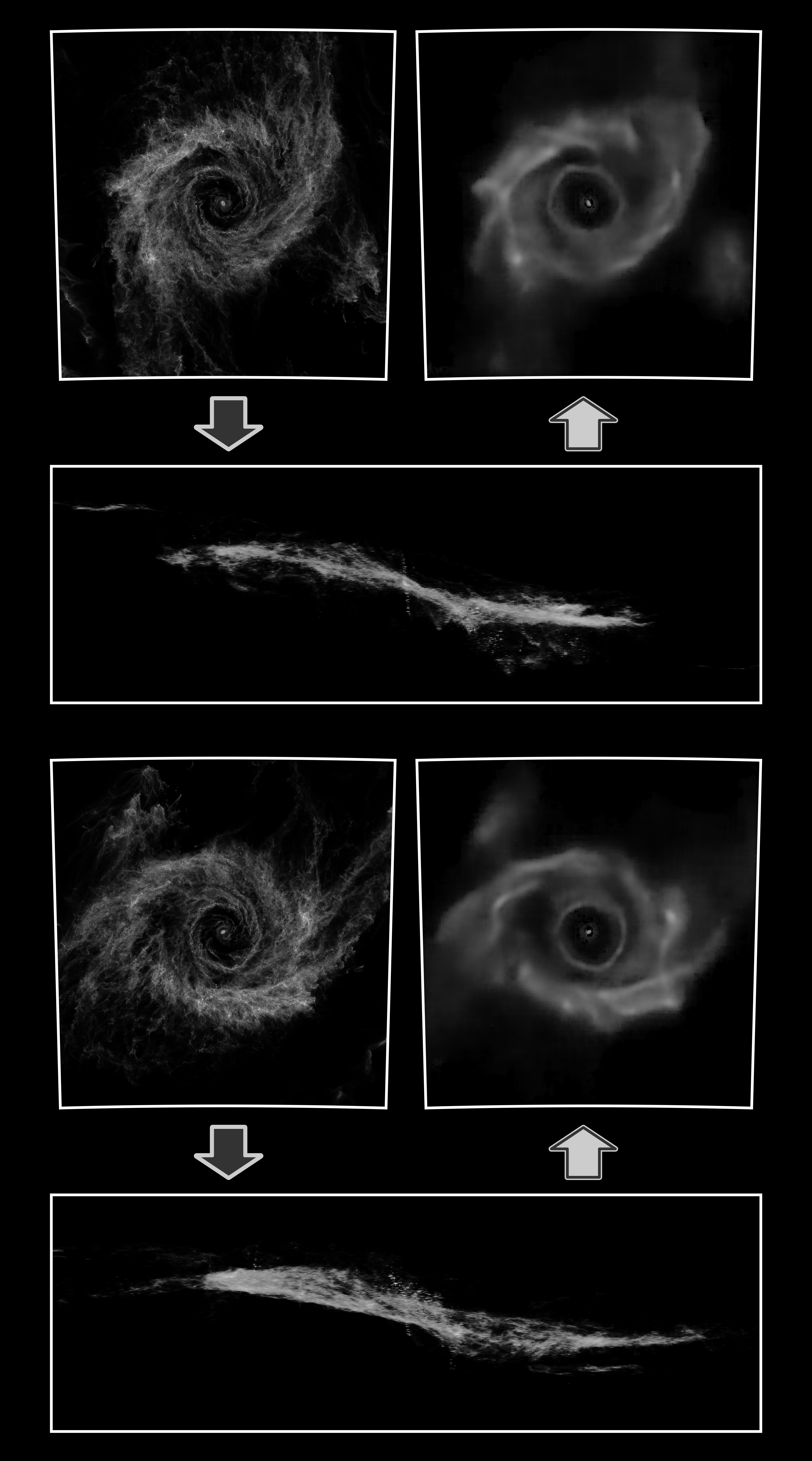
I developed IRIS: an ML system for deciphering the structure of the galactic center.
IRIS uses a deep convolutional neural network to transform spectral-line imagery of
our galaxy observed in our edge-on perspective into a top-down perspective, and
trains on synthetic data generated from galactic simulations. IRIS also incorporates
a GPU-accelerated and fully differentiable "synthetic observation" code,
which enables generation of the IRIS training data by simulating the observational
process at up to 10,000 times the speed of comparable, CPU-based codes.
Read the summary on my research page,
the preprint on arXiv,
or visit the code repository at GitHub.
Mathematics
I have a BS in Mathematics from the University of Connecticut.
In completing my degree, I undertook substantial graduate coursework,
including multiple semesters of abstract algebra and courses in modern analysis,
measure theory, and functional analysis. I see mathematics as both the
language in which I conceptualize ML science and a style of thought with which
I approach problems in general. Beyond just building code in PyTorch,
my experience leads me to believe that strong ML research and development
begins with an understanding of the why and an ability to reason abstractly
about the how. Mathematics is not only the language in which I understand
that why but the style of thought with which I approach that how.
Perspective
Before pursuing a lifelong passion for STEM to a new career in ML science,
I spent most of my 20s in the military, primarily as a Green Beret.
It was, in fact, my experiences in the defense community that spurred my
interest in ML research. While I began coding as a kid, I was inspired to begin
self-educating in ML development in around 2019, as I became
convinced of the centrality of AI to the unfolding era of great-power competition.
In the intervening years, I have only grown more certain of this thesis.
And even with my military career behind me,
my defense experiences continue to inform the way I approach the development of
AI technologies as first and foremost an issue of not only
national security but human security.